
Members
Current Projects
Current Publication

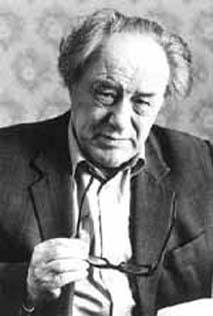 Nikita N. Moiseev |
In September 1976 initiative of Academician Nikita N. Moiseev from the Computing Centre of the USSR Academy of Sciences gave start to new Laboratory of Mathematical Ecology headed by Yuri M. Svirezhev. His first pupils and co-workers were Vladimir P. Pasekov, Alexander M. Tarko, Nikolay K. Lukyanov, Dmitry O. Logofet, Dmitry A. Sarancha, Nikolay N. Timofeev, Valery N. Razzhevaikin. There was a time when introduction of mathematics into biological sciences began to spread to their new branches, in particular, ecology and genetics, and Laboratory of Mathematical Ecology - being the first scientific subdivision with such title in the USSR - took very active part in this process.
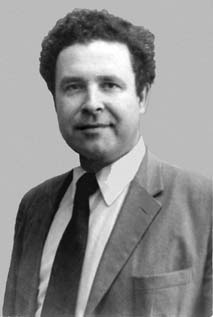 Yuri M.
Svirezhev |
During those years the Laboratory collaborators worked over the models of
biological species co-evolution, obtained general dynamic equations of
evolving populations, established adoptability boundaries for classical
equations of mathematical genetics, obtained generalization of Fisher's
"fundamental theorem of natural selection", formulated general variational
principles of mathematical genetics, developed mathematical theory of
genotypical polymorphism in natural populations. These explorations have
allowed them to explain results of numerous genetic experiments and
observations on genotypic dynamics of real populations. Stability
theory for biological communities as one of most important parts of
mathematical ecology was developed for mathematical models of interacting
biological species. Accurate derivation of general equations of mathematical
ecology based on mass and energy conservation laws made possible to
establish applicability frames for the classical Lotka-Volterra equations
in modeling biological communities. Accurate mathematical basis and new
formulation of McArtur's "Principle of dense packing" for species in
ecological niche space gave opportunity to make important estimates
on perspectives for new species to invade into competing communities.
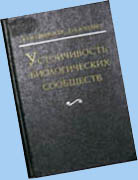
Published in 1978 the monograph "Stability of Biological Communities"
(English translation issued in 1983) by Yu.M. Svirezhev and D.O. Logofet
rapidly became classic in mathematical ecology.
In those years the Laboratory actively started a research aimed to develop
methods of mathematical modeling global biosphere processes and studying
conditions of co-evolution for human society and environment. The attempt
was undertaken to formalize conceptions of the classical Russian
naturalist's school in which a human Individual was an integral
part of the Biosphere, and social evolution appeared as co-evolution
of Human and Biosphere. This study provided a new approach allowing
to formalize description of ecological processes at global level and
developed a system of simulation models for biosphere processes. Now
this system is well-known as Moscow Biosphere Model. The proposed
approach determined directions of global Earth system modeling for
a long time.
In 1979 an international scientific project "Ecosystem Dynamics in Freshwater
Wetlands and Shallow Water Bodies" was initiated by Academician
Anatoly A. Dorodnitsyn under the aegis of SCOPE (Scientific
Committee on Problems of the Environment). Scientific supervision was
carried out by outstanding system's ecologists and ecological modelers
Prof. Bernard C. Patten (USA) and Sven E. Jorgensen (Denmark) while practical
realization of such enormous scaled project entirely fell on the Laboratory
collaborators and PhD students of Yu.M. Svirezhev. In particular,
Dmitry O. Logofet became the project director and was the Head of corresponding
structural unit at the Centre for International Projects of USSR State
Committee for Science and Technology. This project covered a wide range
of ecological problems in wetlands and contributed to the progress of
knowledge about wetland ecosystems structure and functioning. For the
first time in the world practice the Laboratory collaborators designed a
nonlinear model of combined carbon-nitrogen cycles in the local mesotrophic
bog ecosystem which allowed for a phytocenosis structure and competition
for nutrients supply. The simulation model helped to make quantitative
estimates for such characteristics of bog hydrological regime as average
duration of spring underflooding of forest stand roots, probability of
their underflooding during the whole vegetation period, magnitudes of
water table oscillations. The model allowed one to estimate annual changes
of hydrological conditions under phytocenosis dynamics. Also formation of
a hummock-ridge complex (a regular structure of hummocks and ridges at
the bog surface) was reproduced for the first time as an appearance of
a dissipative structure in reaction-diffusion equations. In this spatially
distributed model essential features of oligotrophic bog dynamics were
managed to reproduce: forming a cupola and dependence of relief on a
linear size of the bog.
In early 1980s a new young researchers appeared in the Laboratory: Alexei
Voinov, Mikhail Smirnov, Mikhail Semenov, Petr Raczko. They were engaged
in a plenty of fascinating scientific problems: A. Voinov was interested
in modeling freshwater ecosystems, M. Smirnov - in genetics, M. Semenov -
in agroecosystems simulation, P. Raczko - in forest stand dynamics.
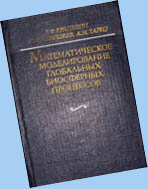
A whole set of books was published: "Modelling of Global Biosphere Processes"
by V. Krapivin, Yu. Svirezhev, A. Tarko, "Models of Evolutionary Genetics"
by Yu. Svirezhev, V. Pasekov etc.
One of the most priority problems during those years for the international
scientific community was an assessment of consequences of nuclear war as
well as a wide spreading of information about it for both world governments
and human communities. Computing Centre of the Soviet Academy of Sciences
as a whole and Laboratory of Mathematical Ecology took a very active part
in this activities. On the basis of available physical, chemical and biological
(especially, radio-biological) information and data the research group
headed by Prof. Yu.M. Svirezhev worked out a model approach giving
quantitative estimates of ecological consequences of global nuclear
conflict in the long run. Final results obtained by this group were
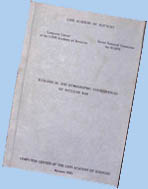
published in English by Computing Centre in 1985 in the book
"Ecological and Demographic Consequences of the Nuclear War" which rapidly
became well-known in the world and then was translated into Russian,
Spanish and German. Much of its materials were included into the famous
two-volume issue by SCOPE named as "Consequences of a Nuclear War for the Environment".
In 1985 the Laboratory appeared in the centre of typical for the
"perestroika" times public movement protested against the plan for transfer
of fraction of Northern rivers run-off to the South (in everyday language,
simply "rivers transfer" ). Yu.M. Svirezhev became a head of informal group
which posed a problem to show falseness of models and forecasts constituted
a "scientific basis of the project", in particular, prognosis for the
Caspian Sea level dynamics. Certainly, almost all the Laboratory participated
in work of this group. These activities have played an important part in
stopping the works on rivers run-off transfer.
About this time contacts with physicians engaged in space projects at the
Institute of Medical and Biological Problems began to be actively developed.
They resulted in performing of the Laboratory into Department of
Mathematical Modeling in Ecology and Medicine. Very close relations
appeared between the new Department and Informational and Computing
Centre of this Institute. New technologies of medical information
processing and new approaches to forecasting a state of human health
in space flights were introduced into work of Informational and Computing Centre.
In the late 1980s former PhD students of the Computing Centre Georgii Alexandrov,
Konstantin Chevelev, Leonid Golubyatnikov, as well as a graduate from the
Moscow Institute of Transport Engineers Sergey Venevsky, came to the Department.
During those years some new modeling approaches were developed both for
solving problems of spreading heterogeneities in "ecologically active media"
(outbreaks of forest and agricultural insects, epidemics) and in a problem
of discrete structure appearance as a result of continuous interactions
between ecosystem components. Proposed eco-energetic analysis of
agro-ecosystems allowed one to compare ecological effectiveness of their
different types and agricultural systems at the regional level. The
method was used for analyzing agriculture of Hungary and served as a
basis for a conception of "adaptive agriculture" suggested together
with Hungarian scientists. Results of the Department works in the
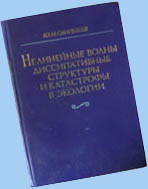
middle 1980s are reflected in Yu.M. Svirezhev's monograph
"Nonlinear Waves, Dissipative Structures and Catastrophes in Ecology" (1987).
When 1990s, years of cardinal political and economic reforms in Russia,
started, the Department has disrupted, and one of its parts headed by
Yu.M. Svirezhev removed to the Institute of Atmospheric Physics and organized
there a Laboratory of Mathematical Ecology while the rest collaborators
stayed at the Computing Centre scattering about different departments.
At the new workplace the Laboratory co-workers took an active part in
studies under State science-technological programs "Ecological Security of Russia",
"Ecology of Russia", "Global Change of Natural Environment and Climate".
In 1992 Yu.M. Svirezhev was invited to be the Head for Department of Systems
Analysis at Potsdam Institute of Climate Impact Research (Germany).
Acting chief became at first K.V. Chevelev and then since 1994
L.L. Golubyatnikov soon approved by Scientific Council as the Head.
Those years were definitely hard for our group: financing of Russian
projects practically stopped, some collaborators left for working abroad,
talented students preferred to make business rather than science…
Nevertheless, the Laboratory remained standing and saved its scientific
potential. In the years some new works were carried out: methodology and
quantitative estimate of ecological risk at local and regional levels
provided high degree of uncertainty, model of estimating the total
carbon exchange flux for natural terrestrial ecosystems (i.e., difference
between carbon input in the net primary production and its emission
from dead organic matter and soils under biotic and abiotic factors)
which allows to distinguish ecosystems as carbon sources and sinks and
to determine their intensity. Also worked out was a new theory of
simplest dynamic model of the global vegetation pattern. New type of
stochastic Markov chain models of successions was created in which
probabilities of transitions between states are not constant depending
on climate-sensible environmental factors. These factors, in turn,
depend on time due to accepted climate change scenarios. Models of that
type are able to describe changes of vegetation cover during a succession
process against a background of climate fluctuations and anthropogenic
perturbations of ecosystems.
In the beginning of the new century Laboratory has been replenished with
young colleagues Olga Feldman, Nikolay Zavalishin, Iya Klochkova. Since 2002
the Laboratory has been led by the deputy director of the A.M. Obukhov
Institute of Atmospheric Physics Alexander S. Ginzburg. At present our
Laboratory works in the following directions: mathematical models of carbon
fluxes in terrestrial ecosystems, reactions of plant canopy to possible
climate changes, matrix models of age-stage-structured plant populations,
eco-energetic analysis of agro-ecosystems, stability and bifurcations
in dynamic compartment models for ecosystems, dynamic models of global
vegetation pattern and its reaction to climate change and human activities,
Markov chain models of vegetation cover successions.
Mathematical Models for Ecosystems